
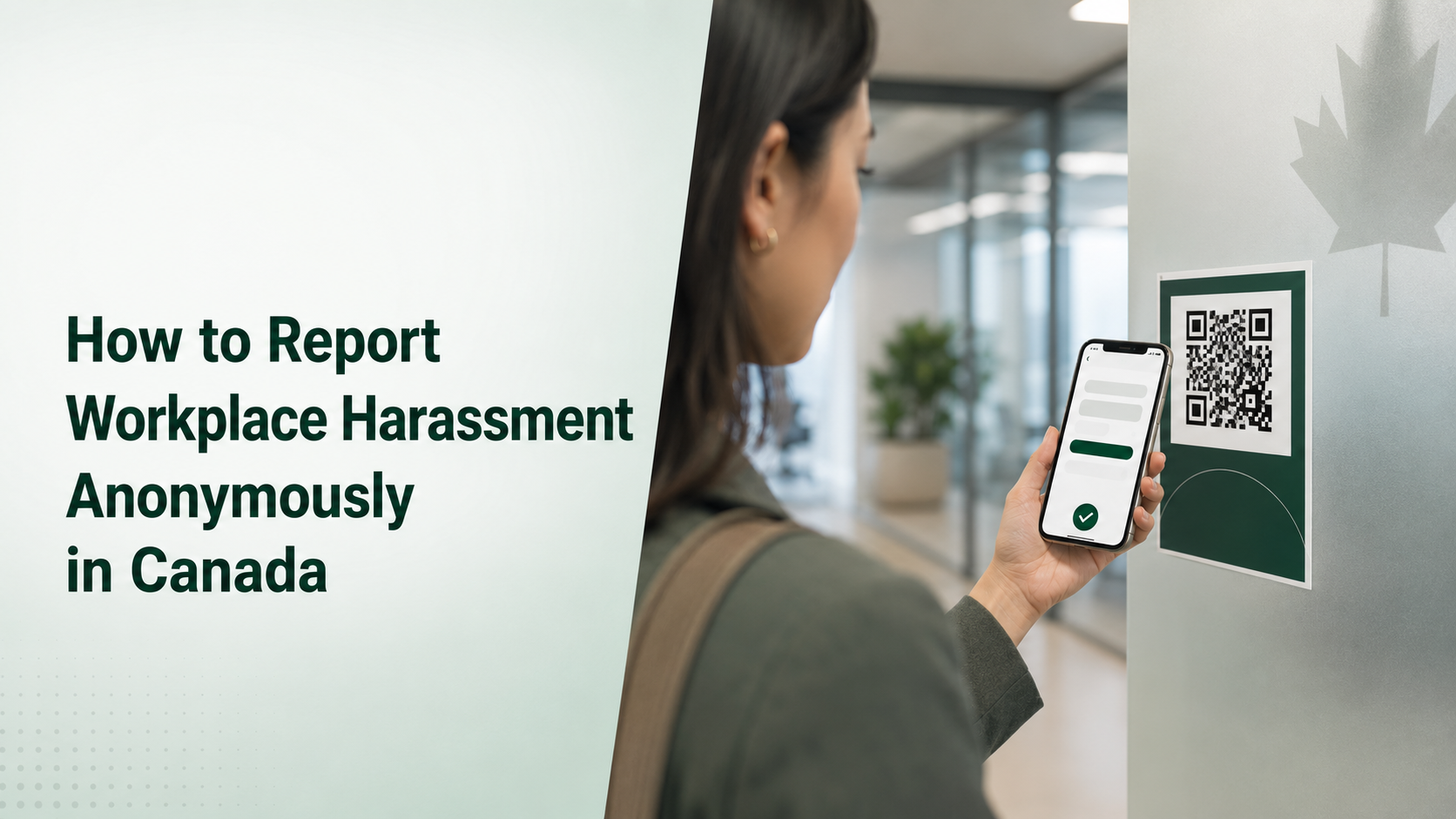
Deciding to report harassment at work is hard enough without the added worry of what happens to you afterward. Will your name get out? Will your manager find out it was you? Could it cost you your job, your shifts, your standing with the team? Those fears are real, and they’re the single biggest reason people stay quiet about things they shouldn’t have to put up with.
The good news: in Canada, you usually have more than one way to raise a concern, and several of them let you stay anonymous. This guide walks through your options, what “anonymous” actually means in practice, and how to choose the route that fits your situation.
First, know that you’re allowed to do this
You have a right to a workplace free from harassment. In most Canadian workplaces, employees generally have the right to raise workplace harassment concerns without facing retaliation. Across the country, provincial frameworks expect employers to have a way for people to raise harassment concerns — and increasingly, to protect anyone who speaks up from retaliation. You do not need to have every detail proven before raising a concern, but it is helpful to document what happened, when, where, and who was involved. If something happened that made your workplace feel unsafe or degrading, that’s usually enough to say something.
The question most people get stuck on isn’t whether to report. It’s how to do it without exposing themselves.
What “anonymous” really means
It’s worth being precise here, because the word gets used loosely.
Confidential usually means someone — HR, an investigator, a manager — knows who you are but agrees to limit who else finds out.
Anonymous means your identity isn’t attached to the report at all. The people receiving it don’t know it came from you.
Those are very different levels of protection, and which one you get depends entirely on the channel you use. A conversation with your manager is not anonymous. An email from your work account is not anonymous. Even some formal reporting systems quietly tie your report back to a login or a phone number. If staying unidentified matters to you, the channel you choose is the whole game.
Your options for reporting in Canada
1. Tell a manager or HR directly
The most direct route is also the least anonymous. Speaking to a supervisor or HR person means they know it’s you. For some people in some situations, that’s fine — especially if you trust the person and want a fast, direct response.
The downsides are obvious if your concern involves a manager, or if you work somewhere small where word travels. It also tends to leave a thin record: a hallway conversation or a quick chat is easy to remember differently later, or to lose track of entirely.
2. Go to a provincial or external body
Depending on your province, there are outside organizations that handle workplace complaints — labour standards bodies, occupational health and safety regulators, and similar agencies. These are worth knowing about, particularly if internal reporting has failed or isn’t safe. The trade-off is that these processes are usually more formal, slower, and generally not anonymous, since the body often needs to be able to contact you.
3. Use an anonymous reporting tool
This is the option built specifically for the problem this article is about: raising a concern without revealing who you are. A growing number of Canadian organizations now use an anonymous reporting platform precisely so employees have a safe channel that doesn’t run through a manager’s inbox.
The rest of this guide focuses on how that kind of tool works, because it’s the one most people don’t fully understand — and the one that most directly answers “how do I report this without it coming back to me.”
How anonymous reporting tools actually work
If your employer uses a tool like SignalitUP, the experience is designed to be quick and low-stakes. Here’s what that looks like from the employee side.
You scan a QR code. Many workplaces post these somewhere visible — a break room, a hallway, a bulletin board. You scan it with your own phone. There’s no app to download and no account to create. You just scan the code and submit a signal, usually in under a minute. That single design choice — no app, no login — is a big part of why people actually use these tools instead of giving up halfway through a setup screen.
You submit your report. You describe what happened in your own words. With a tool built around true anonymity, you’re not asked for a phone number or an email address, and no personally identifying information is collected by default. Your identity isn’t riding along with the report.
You can still have a conversation. This is the part people don’t expect. Good anonymous tools include two-way anonymous chat, which means whoever is handling the report can ask you follow-up questions — and you can answer — without anyone ever learning who you are. So “anonymous” doesn’t have to mean “fire it off and hope.” You can clarify, add detail, and respond, all while staying unidentified.
Then it’s on record. Once you submit, the concern is logged. It exists as a documented item rather than a memory of a conversation, which makes it harder to ignore or quietly drop.
The reason this matters goes beyond your individual case. When people trust that reporting is genuinely anonymous, more of them speak up — and problems that used to stay hidden start surfacing. You reporting safely makes it a little safer for the next person too.
What happens after you report?
This is the other big unknown that keeps people from acting, so it’s worth setting expectations.
With an anonymous tool, submitting isn’t the end of the line — it’s the start of a documented process. Your report doesn’t vanish into a void; it’s logged, and the people responsible for handling these concerns are alerted that something has come in. From there, they can review it and follow up.
If the tool has two-way anonymous chat, you may get a follow-up question through that channel. You’re never obligated to answer in a way that identifies you, and a well-built tool won’t ask you to. You can share as much or as little as you’re comfortable with, and the back-and-forth stays anonymous throughout.
What you generally won’t get is a play-by-play of any disciplinary action involving other people — that side of things is usually kept confidential, the same way you’d want your own report kept confidential. That can feel frustrating if you’re hoping for visible proof that something happened. But “I didn’t hear the outcome” isn’t the same as “nothing happened.” The value of reporting through a real channel is that the concern is on record and in front of the right person, instead of living only in your memory.
What if your workplace doesn’t have a tool like this?
This is a common situation, and it doesn’t leave you stuck.
First, you can still document things for yourself. Keep a private record — on a personal device, not a work one — of what happened, when, where, and who was around. Note dates and details while they’re fresh. You’re not building a legal case; you’re just making sure your own memory is backed up by something.
Second, some anonymous platforms let you raise a concern even if your employer isn’t formally set up on them yet. SignalitUP, for instance, has a “send a signal” option for exactly this: if you have something to report but your organization isn’t set up, you can submit a signal anonymously. Where it goes depends on the contact information available — routing to a specific person relies on your employer already being set up or on suitable public contact details being available, so delivery to the right individual can’t be guaranteed in every case. Even so, it’s a way to get a concern documented and directed toward the appropriate hands without waiting for your workplace to adopt a system.
Choosing the right route for you
A few honest questions usually point to the answer:
Does your concern involve your direct manager or HR? If so, an internal face-to-face route is riskier, and an anonymous channel or external body makes more sense.
How much do you care about staying unidentified? If the answer is “a lot,” rule out anything tied to your name, your work email, or a login — and look for a tool that collects no identifying information by default.
Do you want to be able to answer follow-up questions? If yes, look for two-way anonymous chat rather than a one-shot form, so the conversation can continue without exposing you.
Is your workplace even set up for this? If not, document things yourself and consider a tool that lets you send a signal anyway.
You don’t have to carry it silently
The instinct to stay quiet is understandable — most people worry the cost of speaking up will land on them. But the entire point of anonymous reporting is to take that cost off the table: no name attached, no login, no phone number, often nothing more than a QR code and a minute of your time.
If your employer already uses an anonymous reporting platform, find the QR code and use it; that’s what it’s there for. If they don’t, document what’s happening and look at whether you can send a signal anonymously regardless. Either way, a concern that’s written down and on record is far harder to ignore than one that never leaves your head.
Speaking up shouldn’t require putting yourself at risk. With the right channel, it doesn’t have to.